
COLAPSO
A synth that plays the periodic table.
COLAPSO isn't a synth you program. It's one you explore. Pick an element, excite it, and see what it gives back — tones that sit between instrument and phenomenon, and never quite settle twice.
The short version.
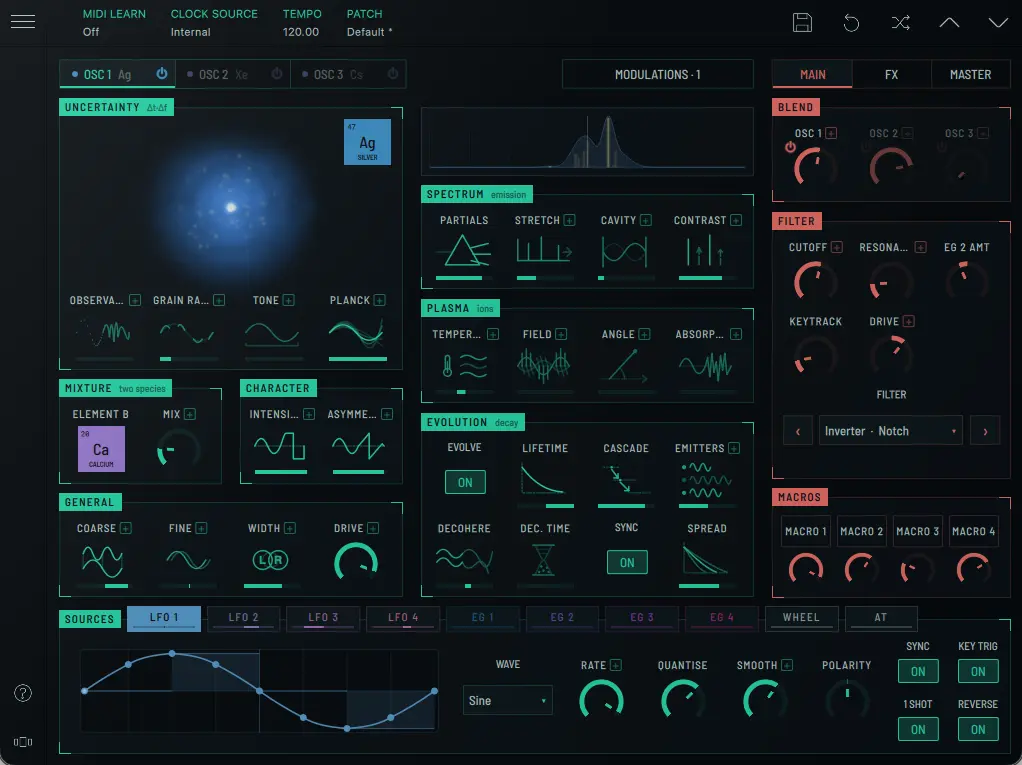
COLAPSO is an additive synthesizer whose harmonic content is measured. Pick an element and its emission lines become the partials of the note you play.
COLAPSO is a sonic interpretation of the uncertainty principle. A sound can be precise in time or precise in pitch, never both — and one control, Observation, decides which. Whatever you don't measure, you hear blur.
An additive synth with a laboratory for an oscillator.
Sixteen partials per voice, per oscillator, their frequencies taken from an element's real spectral lines and their decay times from the measured transition probabilities.
Trades time against frequency, out loud.
Observation moves along the Gabor limit — the signal-processing twin of the uncertainty principle. Planck sets how blurry the universe is at its best.
The physics is the instrument, not the theme.
Lifetimes, level populations, ionisation and cascade are what the controls actually move, and they behave the way the phenomena do.
COLAPSO, in motion.
The Heisenberg Principle.
The Gabor limit, as a knob.
The uncertainty principle says we can't know both an electron's position and its motion precisely at the same time. The more precisely we know one, the less we know the other.
Sound works the same way. To hear pitch, we need time. If we start to shorten the time window, the sound stops being continuous and becomes a series of instants: it collapses into an impulse. Between those two extremes there's a whole sonic territory, and that's where COLAPSO lives.
From light to sound.
Light is a frequency too, forty octaves up.
An element's spectral lines are frequencies of light. COLAPSO keeps the intervals between them and transposes the set down until the strongest line lands on the key you press, so partials fall both below the note and above it. Each line's measured brightness sets its partial's level. Stretch widens or squeezes the intervals; Cavity pulls them onto the harmonic series.
The chooser is the periodic table.
Twenty-two elements, each its own set of partials. Elements in the same column sound related, so the table doubles as a map of timbres. Mix morphs between two: every partial glides towards its counterpart in the other element, while the note you play stays put.
Heat it, magnetise it, flip it into noise.
Temperature rebalances the partials the way heat changes which lines glow, and hot enough it ionises the gas and swaps in a new spectrum. Field splits every partial into three: the original plus a pair a fixed number of hertz either side, which Width spreads in stereo. Absorption crossfades the tone into noise, with a notch at every partial.
Every partial gets its own decay.
In the atom, each line fades at its own measured rate, from under a nanosecond to a few milliseconds. COLAPSO keeps their order and stretches the range into musical time, from tens of milliseconds to several seconds, so strong lines tend to die first, long-lived ones ring on, and the timbre keeps changing while you hold the note. Cascade staggers their attacks; Lifetime speeds them all up or slows them down.
Twenty-two spectra, measured.
Ten sources, no matrix.
LFOs and envelopes you draw.
Four LFOs and four envelope generators, and every one of them is a shape you draw rather than one you pick. Tap to add a node, drag it, bend the line between two. Then drag the source onto any control with a + beside it.
An LFO starts from Sine, Triangle, Saw, Square or S&H and goes wherever you take it. Quantise reads it in steps like a sequencer, Smooth rounds it off, and it runs free, locks to the tempo, restarts on every note or fires once.
An envelope is drawn the same way, across attack, decay, sustain and release: bend the attack into a swell, put a second rise in the decay, shape the tail. Each stage runs from 1 ms to 8 seconds, and velocity scales as much of it as you choose.
LFOs, envelopes and aftertouch run separately for every voice, so the notes of a chord can each move their own way.
The features that stand out.
Hear the elements.
Every sound, made with COLAPSO.
These demos were made entirely inside COLAPSO. No extra synths, no samples from outside. Press play on any track below, from Below the Ground State and Geiger Shuffle to Lithium Rain and Longwave Glacier.
Best on headphones, or anything that reproduces stereo correctly.
Own it your way.
Pay monthly
- Flexible monthly payments
- Pause or cancel anytime
- Same licence as buying once
- Yours to keep after the final payment
Pay one-time
- One-time payment, no subscription
- 14-day refund guarantee
- AU · VST · VST3 · Standalone
- Up to 5 computers per licence
Get the full bundle
- Best value — save vs buying separately
- Desktop licences only
- COLAPSO + DRC + FRMS
Students & teachers, 50% off.
Learning is in our ethos. Verified students and educators get 50% off COLAPSO — same features, same updates. Verify your status, get the code, install.
Will it run on your rig?
macOS 13 or higher
AU, VST3, VST & Standalone. Apple Silicon native (universal binary) · ~333 MB download
Windows 10 or higher
64-bit VST / VST3 host, or the Standalone app · ~68 MB download
Quick answers.
What is COLAPSO?
+
What does the name COLAPSO mean?
+
What does the uncertainty principle have to do with a synthesizer?
+
Which platforms and formats does COLAPSO support?
+
Where do the sounds actually come from?
+
Can I try COLAPSO before buying?
+
Stuck? We got you.
COLAPSO full documentation
Every panel, every parameter, and the physics behind the ones whose names are borrowed from it. Searchable, with diagrams.
Read the manual →Video tutorialsWatch the walkthroughs
Short videos on Observation and Planck, choosing an element, and building a patch that evolves over a held note.
Open YouTube →SupportTalk to Imaginando
Stuck on a licence, a host or a project file? Send us a message — we usually answer the same day, in English or Portuguese.
Open chat →